INTRODUCTION: SITE-SPECIFIC ART and EARTHWORKS
Site-specific art is art that has been designed and built for a specific place. Such art had a long history before the 20th Century, usually in relation to architecture or as architecture itself. Certainly, most large buildings are designed for specific places and works commissioned on or in those buildings are also site specific. A good example of a historical site-specific work of art is the Sistine Chapel ceiling, located in the Vatican in Rome and painted by Michelangelo during the 16th century.
Most, but not all Earthworks are site-specific. These works of art use the earth as the medium and either bring elements of the earth inside or use outside elements as the medium for works that are site-specific.
Earthworks also have a long history before the 20th century. Ancient people in various parts of the world built mounds from earth and inscribed designs on the earth. While it is not clear today as to why these mounds were built or these inscriptions were drawn, it is assumed by many that they had some religious significance to the artists who worked on them.
In the 1960's and early 1970's a number of artists turned their attention to making site-specific paintings, drawings and sculptures and many of them became interested in the environment, the sometimes powerful and sometimes subtle forces of nature, and the earth as a medium for their artistic expression.
Working inside, Sol LeWitt, began to create large wall drawings for specific places. Daniel Buren, working both inside and out of doors, began to paint stripes on specific pieces of architecture. In the late 1960's, Robert Smithson, Walter de Maria and Michael Heizer began to move elements of the earth indoors and in an even more radical move, began moving their art out of museums and galleries altogether and into the landscape, using the earth itself as a medium for extremely large works of sculpture.
Both site-specific artists and artists building earthworks were influenced by the turbulent political situation in the 1960's and both groups of artists attempted to get beyond the art establishment as represented by galleries and museums and the business aspects of the art world. In many respects, their motives in getting out of the traditional art system with art as a commodity were similar to those of the artists involved in Performance art. Both groups tried to produce art that difficult or impossible to collect. Earthworks and site-specific sculptures were often so large that they could not be contained in any museum.
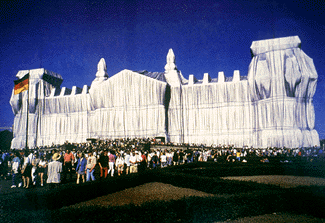
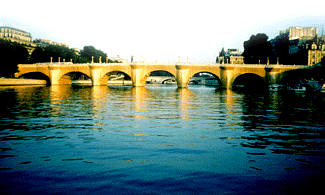
Michael Heizer's "Nine Nevada Depressions" are placed intermittently over a span of 520 miles. Robert Smithson's "Spiral Jetty" is a 1,500-foot-long, fifteen-foot-wide spiral sculpture made from almost 7,000 tons of rock that projects into Utah's Great Salt Lake, not too far from Salt Lake City. Christo's "Running Fence" was 24 miles long, eighteen feet high and was in place for only two weeks. Obviously, all of these works, as well as many others, defied the conventional notion of collecting, purchasing and possessing.
Many of these works are intended to help us to better see and understand our environment. Some demonstrate the rather extreme differences between nature and human endeavor, often revealing our desire to understand, control, and conquer natural processes. Since they are aesthetically motivated and show great care for the environment, they present a dramatic contrast to the willful destruction of the environment that has been part of human progress.
Important site-specific and earthwork artists include Christo, Richard Long, Walter de Maria, Michael Heizer, Andy Goldsworthy, Nancy Holt, Maya Lin, and Robert Smithson.